By Dr. Curtis Westersund, Dentalife Calgary
I’ve been working with TMJ patients for more than 30 years.
During that time, I’ve met people suffering from migraines, jaw, ear, neck, shoulder, eye, sinus and facial pain.
Some knew their jaw might be involved.
Many had absolutely no idea.
They had visited doctors, dentists, physiotherapists and other healthcare providers. They had tried different treatments. Some had been living with discomfort for months. Others had been living with it for years.
And one of the biggest lessons those patients have taught me is surprisingly simple:
Nothing in the human body works in isolation.
TMJ Is About Much More Than Your Jaw
Your temporomandibular joints — your TMJs — connect your lower jaw to your skull.
Obviously, they allow you to open your mouth, chew, speak and yawn. But your jaw doesn’t operate independently from the rest of you.
Muscles connect it to your head and neck. Your bite influences how your jaw functions. Your neck and shoulders influence posture. Your posture can affect how your head sits over your body. Breathing and airway function can also be part of this interconnected system.
That is why my approach to TMJ care has become increasingly biomechanical and whole-body focused over the years.
I don’t just want to know:
“Where does it hurt?”
I want to understand:
“Why does it hurt?”
Sometimes the Pain Shows Up Somewhere Else
This is one of the most frustrating things about TMJ disorders.
You might expect a jaw problem to cause jaw pain.
And it certainly can.
But over the years, I have worked with TMJ patients experiencing:
- Migraines and headaches
- Jaw pain and stiffness
- Ear pain
- Neck pain
- Shoulder pain and tension
- Eye pain
- Sinus-area pain
- Facial pain
That doesn’t mean every migraine, earache, sore neck or sinus problem is caused by a TMJ disorder. Far from it. Pain can have many causes, and getting the right diagnosis matters.
But it does mean we shouldn’t automatically assume that pain in one part of the body begins and ends in that same place.
Sometimes we need to look at the bigger picture.
From Teeth to Toes
I sometimes describe my philosophy as looking at a patient “from teeth to toes.”
It sounds a little unusual coming from a dentist, but after more than three decades of TMJ care, it makes perfect sense to me.
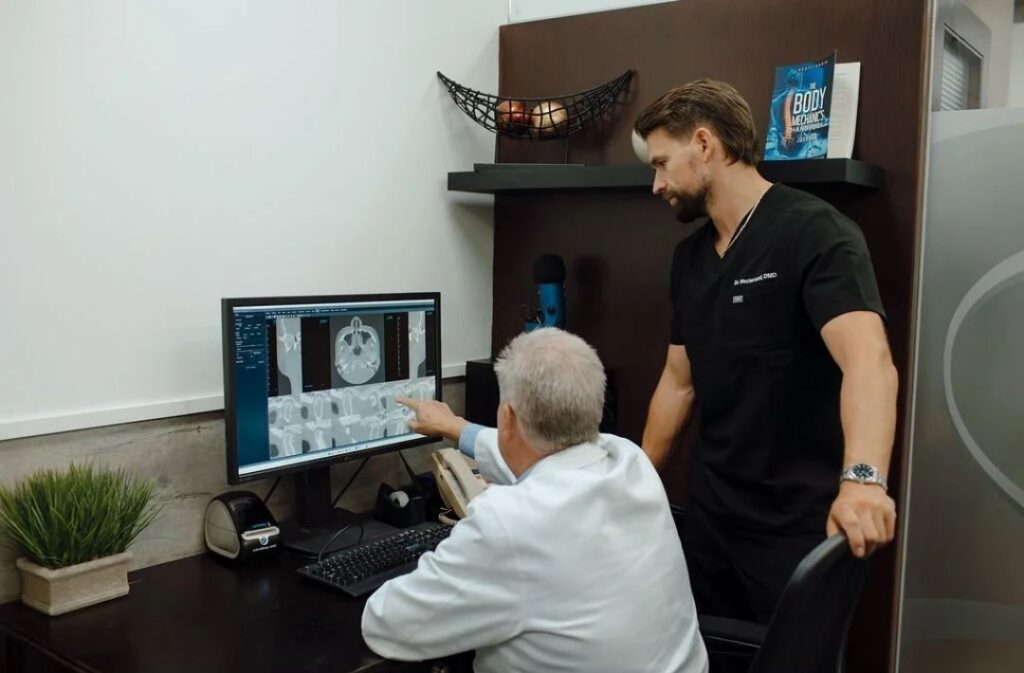
When I assess someone with possible TMD, I am interested in much more than their teeth. I want to understand the jaw joints, bite, muscles, head position, neck, shoulders, posture and breathing — and how those pieces may be interacting.
This is also why TMJ care can involve collaboration with other healthcare professionals. Dentistry has an important role, but we shouldn’t pretend that everything outside the mouth suddenly stops being relevant when a patient sits in a dental chair.
The human body simply isn’t built that way.
30+ Years Changes How You Look at TMJ
Experience doesn’t mean having all the answers.
If anything, 30+ years of treating TMJ patients has taught me to ask more questions, not fewer.
Every patient is different.
Two people can walk into my Calgary dental office describing almost identical jaw pain and still have very different things contributing to it.
That’s why I believe good TMJ care begins with listening, examining and understanding before deciding what treatment — if any — makes sense.
It is also one of the reasons I created Digital TMJ, where I share the knowledge, methods and whole-body philosophy I have developed through decades of clinical TMJ care with other dentists and patients.
You can learn more about this work at Digital TMJ.
You Deserve to Understand Your Pain
If you’ve been living with migraines, jaw pain, ear pain, neck or shoulder discomfort, facial pain or other unexplained symptoms, I know how exhausting that can become.
Pain affects more than the part of your body that hurts.
It can affect how you sleep. How you eat. How you work. Your patience. Your energy. Your relationships. Eventually, it can simply wear you down.
I can’t promise that TMJ treatment is the answer to your pain. No responsible healthcare provider should make that promise. Every patient is different, and individual results will always vary.
But after more than 30 years of caring for people with TMJ disorders, I do believe something very strongly:
You deserve to understand what may be causing your pain.
If your jaw and your body’s biomechanics are part of that story, finding out may be an important first step.
If you’re struggling, please don’t simply accept that pain has become part of your life.
We’ll listen. We’ll look at the whole picture. And we’ll try to understand what your body has been telling you.